Principles of Accounts
Discover how POA empowers students to think, solve, communicate, collaborate and make informed decisions - skills that go beyond the classroom and into the real world.
Our Objectives
Through POA, students will:
Understand how businesses measure and communicate performance, and use both accounting and non-accounting information to make informed decisions.
Develop transferable skills in organising, analysing and evaluating information for decision-making, and apply these skills in everyday life.
Develop positive values and dispositions, such as integrity and objectivity, to guide them in communicating information and making responsible decisions.
Our Approach
At SJC, our POA lessons adopt five key teaching strategies to make learning active, meaningful and connected to real-world applications.
1. Questioning
Purposeful questioning encourages students to think deeply, ask questions and develop understanding.
2. Processing
Students practice, apply and deepen their learning through guided activities, with opportunities to receive feedback and improve.
3. Connecting
Students connect new knowledge with prior learning, helping them understand how different accounting concepts and ideas are related.
4. Reflecting
Students reflect on their learning by discussing, explaining and evaluating their thinking, enabling them to identify and correct misconceptions.
5. Scenarios for Decision-Making
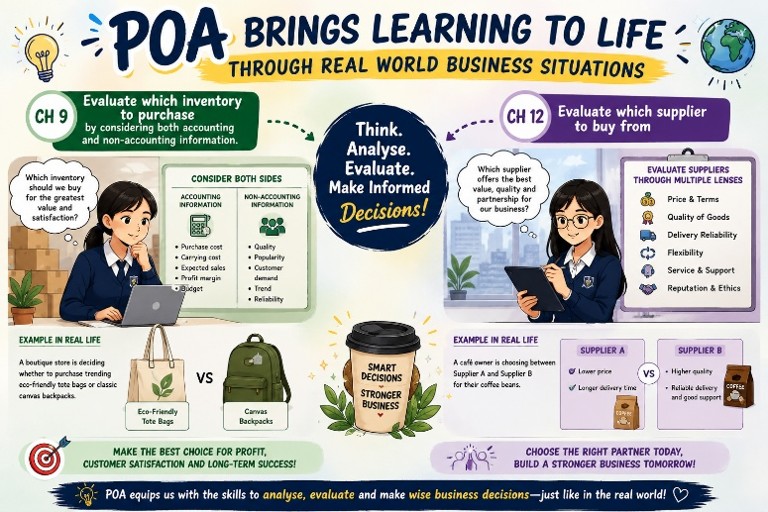
Real-world business scenarios allow students to gather and analyze information, evaluate options and justify decisions using both accounting and non-accounting information. This develops their inquiry, analytical and decision-making skills.
Our Programmes
At SJC, our POA programme goes beyond learning how to record transactions. Students develop three interconnected dimensions of accounting knowledge: contextual knowledge, which involves understanding businesses and their activities; conceptual knowledge, which focuses on applying accounting concepts and principles; and procedural knowledge, which equips students with the skills to record and communicate financial information effectively.
As technology transforms the accounting profession, accountants are increasingly required to analyze information, add value and make informed business decisions. Our POA programme therefore provides students with opportunities to understand business situations, apply accounting concepts, interpret information and evaluate options to make sound decisions.
Learning is made interactive, collaborative and meaningful through the use of digital tools such as Kahoot, Nearpod, SLS and ClassPoint. These tools also support Assessment for Learning, enabling teachers and students to monitor learning and identify areas for improvement.
Students learn collaboratively through pair and group discussions, Gallery Walks and Frontier Teaching, where they exchange ideas and learn from their peers. Hands-on activities and real-world business situations further help students connect classroom learning to everyday life and develop essential skills in critical thinking, problem-solving, communication, collaboration and decision-making.
.png)
Competitions
At SJC, we encourage our POA students to participate in competitions whenever opportunities arise, allowing them to apply what they have learnt in the classroom to real-world contexts.
These experiences provide opportunities for students to develop critical-thinking and problem-solving skills as they tackle authentic business and financial challenges.
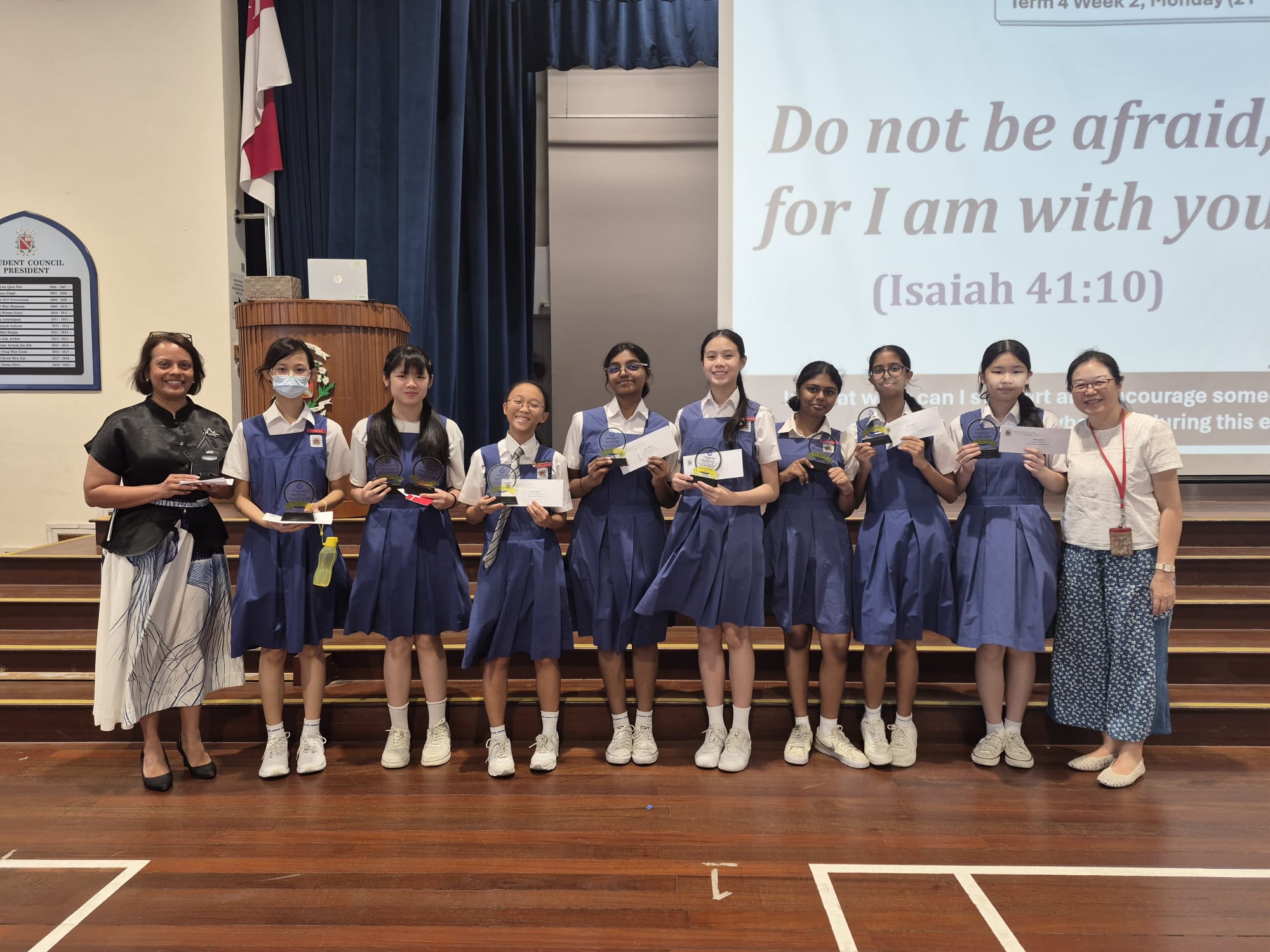
On 12 August 2026, ten students participated in the National Accounting Challenge and achieved Second Runner-Up positions in both the Individual and Team categories.
.png)